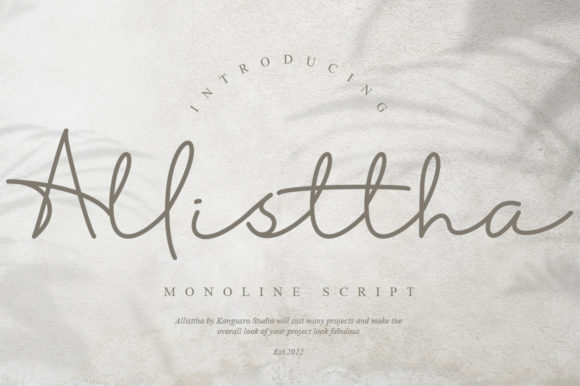
Allisttha: A Vintage Script for Modern Design
There’s a particular quality in a handwritten script that feels both timeless and deeply personal. It’s the slight irregularity, the flow of the line, the impression that a human hand guided the pen. Allisttha captures this essence beautifully. It’s a vintage-styled script font, but don’t let the “vintage” label fool you into thinking it’s stuffy or outdated. Instead, it carries a sense of established elegance and warmth, reminiscent of carefully crafted invitations and personal correspondence from an era that valued tactile communication.
Visually, Allisttha strikes a balance between decorative flair and functional clarity. Its letterforms feature graceful, looping connections and a moderate slant that suggests movement without sacrificing stability. The strokes vary naturally, mimicking the pressure variations of a broad-nibbed pen or brush. This gives it a textured, authentic feel that many purely digital script fonts lack. It’s not trying to be a casual, messy handwritten font; it’s a refined, polished script with a distinct personality. Think of it as the typeface equivalent of a well-tailored vintage suit—classic, sophisticated, and always appropriate for occasions that call for a touch of class.
Where Allisttha Truly Shines
The real test of any creative font is its application. Where does Allisttha work best? Its strength lies in projects where you want to convey warmth, authenticity, and a handcrafted sensibility. For entrepreneurs and small business owners, this font can become a cornerstone of a memorable brand identity. Imagine it on a boutique bakery’s logo, the header of a handmade artisan’s website, or the label for a small-batch skincare product. It instantly communicates care, quality, and a personal touch.
In marketing and advertising, Allisttha excels at creating emotional connection. Use it for headline text on a poster for a local theater production, the main calligraphy on a wedding venue’s brochure, or the featured quote in a social media graphic promoting a creative workshop. Its vintage character makes it particularly effective for brands with a heritage story, for whiskey labels, for craft breweries, or for any product that leans into its roots and history. It’s a fantastic display font for creating a strong first impression in headlines, titles, and logos.
Beyond commercial use, its appeal is just as strong for personal projects. It transforms wedding invitations, save-the-dates, and thank-you cards from simple stationery into keepsakes. Bloggers and content creators can use it to add a distinctive, personal signature to their digital headers or PDF downloads. The key is recognizing its role: Allisttha is a star performer in short, impactful bursts of text where its character can be fully appreciated.
Practical Guidance for Using This Script Font
Choosing a font is a practical decision, not just an aesthetic one. Here’s how to evaluate and implement Allisttha effectively. First, consider your project’s tone. Allisttha’s vintage, elegant personality is perfect for projects that aim for sophistication, romance, nostalgia, or artisanal quality. It might be less suitable for a cutting-edge tech startup or a corporate financial report, where a clean sans serif font would project a different kind of trust.
Readability is paramount, especially for body text. Allisttha, like most script and display fonts, is designed for impact at larger sizes. Its intricate ligatures and connections can become difficult to parse in long paragraphs of small text. Use it strategically for headlines, subheadings, pull quotes, or single lines of emphasis. Pair it with a highly legible serif font or a neutral sans serif font for body copy. A strong font pairing is essential; let Allisttha provide the flair and let a workhorse typeface handle the heavy lifting of readability.
When you acquire a premium font like Allisttha, always review the full character set and included styles. Check for essential glyphs you might need: numerals, punctuation, currency symbols, and common diacritical marks. See if it includes stylistic alternates or swashes—these can offer valuable variety for customization. Finally, understand the licensing. A commercial font license is an investment in your project’s professionalism. Ensure the license covers your intended use, whether for a client’s logo, a product for sale, or widespread digital distribution.
In a world saturated with generic typefaces, a well-chosen font like Allisttha does more than display words. It sets a mood, tells a story, and builds a layer of trust and recognition with your audience. It’s a design asset that can elevate a simple project into something with depth and character. By applying it thoughtfully—honoring its strengths and mitigating its limitations—you can harness its vintage charm to create modern designs that feel genuinely human and deeply engaging.